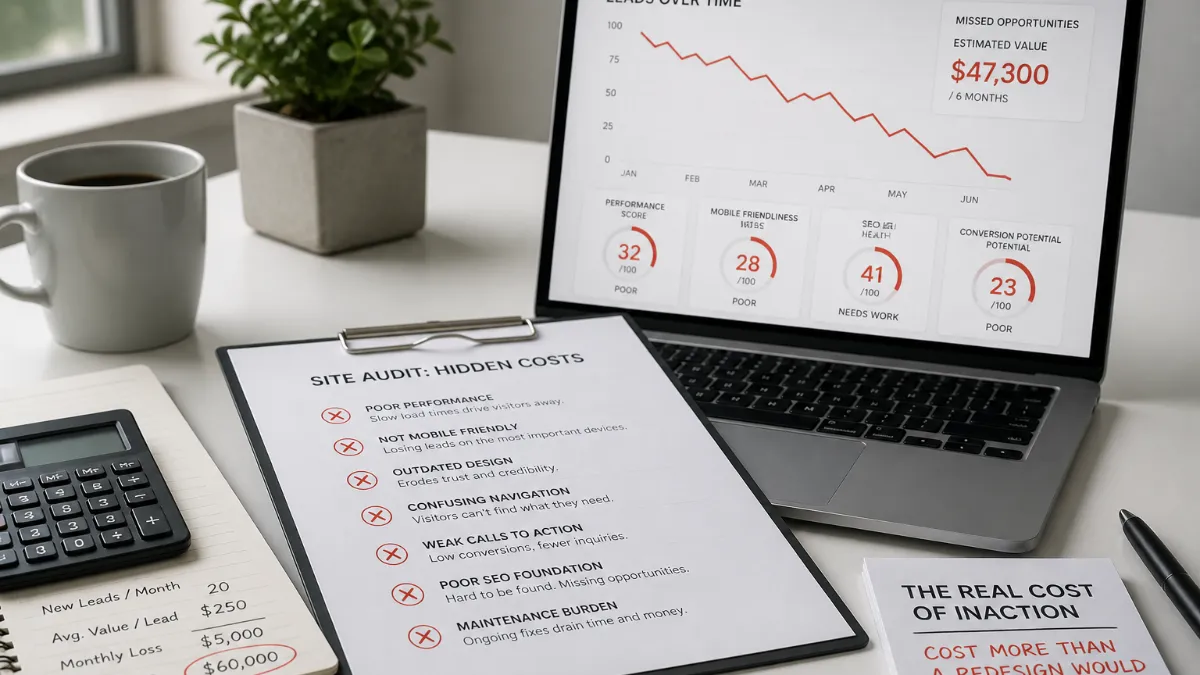
7 Signs Your Site Is Costing More Than a Redesign Would
By Dori Fussmann · August 24, 2026
There is a version of this calculation that most small business owners have never done, and it is quietly costing them money every month. The question is not whether a website rebuild costs something — it does. The question is whether an underperforming website is already costing more in lost leads, lost credibility, and lost search visibility than a rebuild would. For most of the small service businesses that reach this question, the honest answer is yes. The signs are specific, they are diagnosable, and they show up well before a business owner is willing to admit that the problem is structural.
Here are seven of those signs. If three or more feel familiar, the cost-of-inaction math has almost certainly flipped.
Sign 1: Your Pages Take More Than Three Seconds to Load on Mobile
Speed is not a cosmetic issue. It is a revenue issue with a measurable rate. 53% of mobile users abandon a site if it takes longer than 3 seconds to load. That is not a user experience complaint — it is more than half your potential customers gone before they have read a single word about your services. The conversion loss compounds quickly: a 1-second delay in page load time results in a 7% reduction in conversions, 11% fewer page views, and a 16% decrease in customer satisfaction.
The ranking damage runs alongside the revenue damage. Google confirmed page speed as a ranking factor for both mobile and desktop search, and Core Web Vitals became a direct ranking signal in 2021 — meaning sites failing Core Web Vitals thresholds face ranking penalties that create compounding visibility and traffic loss. For a local plumber, electrician, or landscaper who depends on appearing in location-based searches, a slow site is not just pushing visitors away — it is actively suppressing the number of visitors who ever arrive.
The root cause is almost always structural. Poor hosting accounts for 37% of slow loading issues, and sites built with heavy themes load 2–4 seconds slower on average. These are not problems that can be solved by optimising one image or deleting one plugin. They are platform-level constraints that a rebuild addresses at the foundation.
Sign 2: You Cannot Find Your Own Business on Google for Your Core Service and City
Type your service and your city into Google. If your site does not appear on the first page — or does not appear at all — the problem is almost certainly technical rather than competitive. A plumber in Austin who cannot rank for “plumber Austin” is not being beaten by better businesses; the site’s structure is making it invisible to the systems that allocate that traffic.
The specific culprits are well documented. Missing schema markup means Google and AI systems cannot confidently establish what your business is, where it operates, or what it offers. Weak internal linking means that authority cannot flow between pages. Poor crawlability means that even the content you have written may not be fully indexed. Structured data, secure HTTPS connections, and logical internal linking are no longer “nice to have” — they are baseline requirements for being considered authoritative.
These are not patch-level fixes. A site that was built on an older CMS without schema support, with a flat page structure and no internal linking strategy, requires a rebuild to fix properly. Bolting on a schema plugin to a structurally weak site is the equivalent of adding GPS to a car with no engine — the signal arrives, but the vehicle is still not going anywhere.
Sign 3: Visitors Land and Leave Without Contacting You
A high bounce rate and a non-converting contact form are not independent problems. They are two readings of the same underlying failure: the site is not building trust quickly enough to motivate action. If more than seven out of ten visitors leave without interacting, the site is not building trust fast enough — the first three seconds are not working.
Trust is not built through clever copywriting alone. Trust signals — reviews, testimonials, security indicators, and clear contact information — are the currency of small business websites in 2026, because visitors decide whether to trust a business in seconds and skepticism is the default. Strong trust signals convert hesitant visitors; their absence sends them to a competitor who looks safer.
The industry benchmark makes the cost concrete. The industry average landing page conversion rate is 2.35%, and the top 25% of converting sites achieve at least 5.31% — a rate below 1% indicates that visitors are arriving but not trusting enough to take action. For a service business receiving even a modest 300 visitors a month, the gap between a 0.5% conversion rate and a 2.5% conversion rate is six additional leads per month. At any meaningful transaction value, that gap pays for a rebuild in a matter of weeks.
Sign 4: Your Business Is Invisible to AI Search Tools
The discovery landscape for local businesses shifted materially in 2025 and accelerated into 2026. ChatGPT and other AI platforms have become the third-most-popular source of local business recommendations, trailing only Google and Facebook. At the same time, AI Overview now appears in approximately 64% of searches in the United States, meaning that in nearly two out of three searches, an AI-generated answer displays at the very top before any organic results.
Sites that lack structured data, clear entity signals, and well-organised content are functionally invisible to these systems. When a site includes LocalBusiness schema, it tells ChatGPT, Google, and Perplexity: “This is a business called [name], located at [address], serving [area], offering [services]” — the AI does not have to infer any of this from paragraphs and can read it directly from the structured data. Without that signal, the AI either skips the business entirely or surfaces a competitor who made the information explicit.
The platform matters as well. What 2025 revealed is that schema markup evolved from an SEO tactic into core infrastructure for AI understanding, and in the second half of 2025, AI systems started taking action — not just answering questions. A site built on outdated CMS infrastructure, with no schema implementation and poor page structure, is not just missing a ranking opportunity — it is structurally excluded from an increasingly important category of customer discovery.
Sign 5: You Hesitate Before Sending Customers to Your Own Website
This is the sign that business owners are most likely to dismiss as subjective, but it is one of the most reliable. The hesitation is not vanity. It is an accurate read of a real risk: that the impression the site creates will undermine a relationship that took real effort to build.
First impressions are design-driven — 94% of first impressions relate to a website’s design, not the products or service quality on offer. A site that looks dated, loads slowly on a phone, or presents information in a cluttered or confusing way is communicating something specific about the business before a word has been read. The visitor is drawing an inference — about how the business operates, how recently it has invested in itself, and whether it is the kind of provider they want to work with.
For many small businesses — restaurants, salons, professional services — the website is the first impression long before someone walks in the door or fills out an inquiry form. If the site feels outdated, slow, or confusing, visitors often assume the business might be the same way. A modern, strategic small business website tells a different story: that the business is current, credible, and ready to serve. The hesitation a business owner feels before sharing their URL is that inference playing out, correctly, in their own mind.
Sign 6: Your Competitors’ Sites Are Noticeably Faster and Cleaner
Local service markets are comparison markets. A homeowner looking for a roofer, an HVAC technician, or an accountant opens three or four tabs, spends thirty seconds on each, and makes a shortlist. Search engines evaluate whether a site loads quickly and works seamlessly on mobile — and if a potential customer clicks through from an AI summary and the site takes five seconds to load, that friction works against the business.
The competitive gap does not need to be large to be decisive. A competitor whose site loads in two seconds, presents testimonials prominently, and makes the phone number immediately visible on mobile is not doing something extraordinary. They are meeting the minimum standard that a technically competent site delivers. A site that fails to meet that standard is being quietly disqualified from consideration before a conversation ever starts — not because the business is inferior, but because the website signals that it might be.
The most enduring website design principle of recent years is consistent: performance, clarity, accessibility, and authenticity outperform their opposites for businesses serious about converting visitors into customers. Slow, clever, and polished is losing ground to fast, clear, and real. In a local market, the business whose site embodies those qualities wins the shortlist.
Sign 7: You Are Paying Monthly Fees for a Platform That Generates No Leads
This is the sign that reframes the entire affordability question. Many small business owners are already spending money on their website every month — on CMS subscriptions, plugin licences, hosting, and security updates — for a site that generates no measurable leads. The cost is ongoing, the return is negligible, and the situation is not improving on its own.
The alternative framing is straightforward. A one-time rebuild that delivers an owned asset on modern infrastructure — fast, properly structured, schema-equipped, and seeded with targeted content — replaces a stream of monthly fees with a durable organic asset that earns its keep. The monthly fees do not stop the site from being slow, invisible to AI systems, or unconvincing to visitors. They simply sustain the status quo, and the status quo has a cost.
The status quo cost is not abstract. 45% of consumers now use ChatGPT or similar AI tools to find local businesses, up from just 6% a year earlier. A site that is architecturally excluded from that channel — because it lacks schema, because its content is thin, because its structure does not communicate clearly to AI systems — is losing a growing share of potential discovery every month that passes. Paying to maintain that exclusion is, by any reasonable definition, not affordable.
The Calculation Most Owners Do Not Run
The default framing around website investment — “can I afford a redesign?” — assumes that the current site is a neutral baseline. It almost never is. A site that loads slowly, ranks poorly, fails to convert visitors, and is invisible to AI search is actively losing revenue every month. The question is not whether the business can afford a rebuild. It is whether it can afford not to rebuild.
If three or more of these signs are present, the site is almost certainly costing more in lost leads than a properly executed rebuild would. Perfect AI Websites is designed for exactly this moment: a fixed-price rebuild that takes the website a business already has, moves it onto fast and technically excellent infrastructure, adds structured data engineered for both Google and AI discovery, and seeds it with targeted content — without rewriting the brand or reinventing the business. The result is not just a better-looking site. It is a measurable lead-generation asset, and the point at which the rebuild begins paying for itself is closer than most business owners expect.
Where Things Stand
The conditions that make an underperforming small business website costly are becoming more acute in mid-2026, not less. Recent data shows that 45% of consumers now use ChatGPT or similar AI tools to find local businesses — up from just 6% a year earlier — yet ChatGPT currently recommends only about 1.2% of local businesses, making AI visibility roughly 30 times harder to achieve than ranking in Google’s local search results.
AI Overview now appears in approximately 64% of searches in the United States, meaning an AI-generated answer displays before any organic results in nearly two out of three searches. For local service businesses whose sites lack structured data and clear entity signals, this is a compounding disadvantage: the channel is growing while their technical exclusion from it remains unchanged. Recent analysis from industry commentators makes the direction clear — SEO in 2026 is about being clear enough for AI to understand, structured enough for search engines to trust, and helpful enough for customers to choose; small businesses that invest in structured content, technical consistency, and measurable trust signals are positioned to rank better and convert better. For sites still running on legacy infrastructure with no schema and poor mobile performance, the gap between where they are and where the bar now sits is widening with each passing month.
Further reading: small business website redesign · affordable web design for small business · affordable website redesign · affordable website redesign · best website design small business.
Sources: Affordable Website Development for Small Business · The Best Small Business Website Design Options In 2026 · Web Design & Management Services for Small Businesses.
Frequently asked questions
How do I know if my website is actually losing me leads, or if business is just slow?
The clearest indicator is checking Google Search Console for impressions versus clicks. If your site appears in search results but few people click through, the site itself is the problem. If you have very few impressions at all, your technical structure is preventing discovery. Either way, the site is the constraint — not the market.
Can I fix these issues by patching my existing site rather than rebuilding it?
Some signs — like a missing trust badge or an outdated photo — can be patched. But slow load times caused by a bloated CMS, missing schema caused by a platform that doesn't support it, and poor crawlability caused by weak site architecture are structural problems. Patching them on legacy infrastructure is like repainting over rot: the underlying problem persists and the fixes degrade quickly. A rebuild on modern infrastructure solves these at the root.
How much does a professional website rebuild typically cost for a small business?
Fixed-price rebuilds for small service businesses typically range from a few hundred to several thousand dollars depending on scope, the provider, and whether content creation is included. The more useful framing is ROI: if your business closes a single additional customer per month as a result of improved organic visibility, what is that worth annually? For most trades and professional services businesses, the rebuild pays for itself within the first quarter of improved performance.
Will rebuilding my website hurt my existing Google rankings?
A properly managed rebuild preserves and typically improves rankings by maintaining URL structures, implementing proper redirects, improving technical SEO, and adding structured data the old site lacked. The risk of ranking loss comes from poorly managed migrations — changing URLs without redirects, losing page content, or switching to a slower platform. A rebuild engineered specifically for search performance should be a net positive for rankings, not a threat to them.
Related
Sources
About the author

Founder, The Night Ventures
Dori Fussmann is a seasoned finance and operations executive with deep expertise in entrepreneurship, business strategy, and data-driven decision-making. As Chief Financial Officer of BlueMark, Dori leads the firm's financial strategy and planning, operational excellence, and growth execution – helping ensure the organization's continued leadership in impact verification and intelligence. Before joining BlueMark, Dori was the Founder and CEO of The Vets, a U.S. home pet care company. Earlier in his career, Dori spent several years in investment banking at Citi, Ion Pacific, and Morgan Stanley, advising on mergers and acquisitions, IPOs, and strategic financing transactions across consumer and technology sectors. Dori also serves as a mentor in Cornell Tech's Runway Startups Program, supporting early-stage founders working on applied technology solutions. Dori also serves as a mentor in Yale's Tsai Center for Innovative Thinking (Tsai CITY) Thematic Mentoring Program, advising student founders and venture teams on business model development, go-to-market strategy, product positioning, and commercialization pathways. Fluent in English and Hebrew and proficient in German, Dori earned dual degrees in Accounting and Business Management (B.A.) and Law (LL.B.) from the Interdisciplinary Centre (IDC) Herzliya.
SEO Web Design
Design and development with search architecture, technical SEO, performance, and content structure built into the foundation.