Affordable Website Redesign for Small Businesses: A Guide
By Dori Fussmann · August 24, 2026
What “Affordable” Actually Means
The word affordable does a lot of work in small business marketing, and nowhere is it more slippery than in website redesign. Scroll through any search results page for “affordable website redesign” and you will find promises that span roughly $50 per month to $15,000 as a flat project fee — and vendors at every price point using the same word to describe their service. Before you can evaluate any option honestly, you need a working definition that cuts through the noise.
A $3,000 website that brings in $50,000 in business is a better investment than a $500 website that sits there doing nothing. That sentence is the clearest framing of what “affordable” actually means for a small business. The question is never how little you can spend — it is what the minimum investment is that will generate a measurable return. Affordability, properly understood, is a ratio between cost and outcome, not an absolute dollar amount. A low monthly subscription that produces no additional leads is one of the most expensive choices a business owner can make, because the cost accumulates indefinitely while the return never materializes.
In 2026, website redesign ROI is no longer measured only through visual improvements. Businesses now evaluate redesign success based on SEO performance, customer engagement, lead generation, conversions, and long-term revenue growth. This shift in how success is measured is exactly what should shift how you evaluate cost. A redesign that looks polished but is technically weak — slow to load, poorly structured for search engines, invisible to AI discovery systems — is not affordable at any price. It merely rearranges the furniture while the building’s foundation crumbles.
The Price Spectrum: What You Are Actually Buying at Each Tier
Understanding the market requires understanding that each price bracket represents a fundamentally different product, not just a different quantity of the same thing.
DIY Builder Subscriptions (~$10–$50/month)
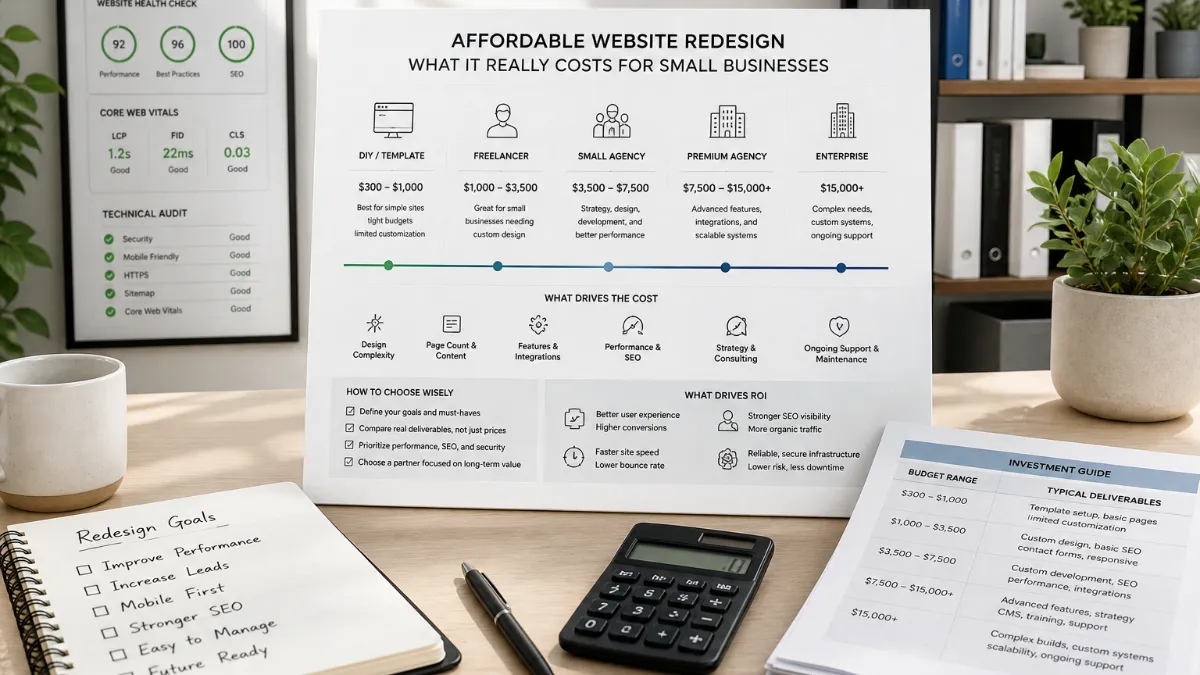
Small business website costs range from $500 for DIY builders to $5,000+ for custom builds. At the low end of that range, drag-and-drop subscription platforms let non-technical owners launch a site quickly without writing a single line of code. The appeal is obvious: the upfront cost is nearly zero and the visual results can look clean and modern. But two serious tradeoffs accompany that low entry price.
First, the time cost is real and frequently underestimated. Building even a simple site from scratch — writing the copy, uploading imagery, configuring navigation, setting up forms — can consume dozens of hours of an owner’s time. For a plumber or HVAC contractor whose billable hour is worth $150–$300, that time cost can rival or exceed a professionally executed rebuild before the site even launches. Second, and more consequentially for long-term search performance, Google now prioritizes mobile-first, fast-loading sites. An old design that isn’t responsive sinks in search results, and with it, your ability to attract new customers. Many subscription builder templates still produce pages that underperform on Core Web Vitals — the technical performance benchmarks Google uses as ranking signals — regardless of how good they look on the surface.
Freelancers ($2,000–$8,000)
For most small businesses in 2026, the average cost of a high-quality, professional website falls between $2,000 and $8,000, with more advanced builds reaching $15,000 or more. A skilled independent freelancer in this range can produce significantly better work than a DIY template — custom layout decisions, proper on-page SEO setup, mobile-first development — but the quality varies enormously depending on the individual’s background. Technical SEO expertise, schema markup implementation, page speed optimization, and crawlability engineering are specialized skills that many generalist web designers do not have. A beautiful site built by a designer without these skills can look like an upgrade on the surface while remaining just as invisible to search engines as the site it replaced.
Specialist Rebuild Services and Small Agencies ($3,000–$15,000)
Small business redesigns usually cost $3,000 to $15,000 with templates and basic features. At this tier, the work typically includes structured planning, proper technical SEO implementation, mobile-first development on a fast infrastructure, and some level of content strategy. The tradeoff at this price point is largely about specificity: a generalist small agency may or may not have genuine expertise in the technical factors — schema markup, crawl efficiency, Core Web Vitals optimization — that determine whether a redesign actually earns more organic traffic. This is why the specification of what is included in a scope of work matters as much as the total price when comparing proposals.
The Technical Factors That Determine Whether a Redesign Works
The single most important thing a small business owner can understand about website redesigns is this: visual quality and technical quality are not the same thing, and in terms of search performance, technical quality is what matters far more.
Google’s own research shows that 53% of mobile users leave a site that takes longer than 3 seconds to load. Page speed is not a nice-to-have — it is a prerequisite for holding the visitors that organic search delivers. If your site is slow, you’re hemorrhaging traffic. Slow sites also rank lower in search results — it’s a double hit. A redesign that migrates a slow WordPress site to a faster hosting plan without addressing the underlying page architecture may improve load times marginally. A redesign that rebuilds on modern static infrastructure — lightweight compiled HTML delivered from a global content delivery network — can cut load times dramatically, which directly improves both Google rankings and user experience.
Beyond page speed, crawlability and schema markup are the two most commonly absent technical elements in budget redesigns. Crawlability means search engines can systematically discover and index every page on your site without running into redirect chains, duplicate content, or broken internal links. Schema markup is structured data added to the site’s code that tells search engines — and increasingly, AI systems — precisely what your business does, where it operates, what services it offers, and what customers say about it. AEO focuses on structuring your website so search engines and AI tools can quickly and accurately interpret what you do, who you serve, and where you do business. A site without schema markup is communicating in vague, interpretable language. A site with it is speaking directly and clearly to the systems that decide whether your business appears when someone asks for recommendations.
This distinction matters more than it ever has before. In 2026, Google reported that AI Overviews had grown to more than 2.5 billion monthly active users, while AI Mode surpassed 1 billion monthly users within a year of launch. AI Mode queries have also more than doubled every quarter since launch, showing how quickly users are adopting answer-led search experiences.
Instead of scrolling through a list of links, potential customers may only see a handful of businesses mentioned in that summary. Whether you’ve noticed these changes or not, they’re already affecting which businesses get seen. If your competitors’ content is easier for AI to understand than yours, they’re more likely to be referenced in these generated answers. A technically weak site will lose this competition by default, regardless of how many years it has been online or how much the owner has invested in paid advertising.
Why High-Value Service Businesses Should Think About This Differently
The ROI calculation for a website redesign is dramatically different depending on the lifetime value of a customer. For a business that sells $15 items, a redesign investment needs to produce hundreds of additional sales to pay for itself. For a plumber whose average job is $400, a dentist whose patient lifetime value exceeds $3,000, an HVAC contractor whose service agreements run $150 per month, or an attorney whose client engagements start at $2,500 — the math changes completely.
If you’re driving 5,000 monthly visits at 1% conversion and you can move it to 2%, you double your lead volume. For most service businesses, that’s a 6–12 month payback. And that calculation assumes traffic stays constant — a redesign that also improves technical SEO typically grows organic traffic over the months following launch, compounding the return. SEO gains typically take 3–6 months as search engines re-crawl and re-evaluate the site. Long-term ROI compounds over time as improved UX, content, and authority continue to attract and convert visitors.
Consider what even a modest improvement in organic visibility means for a roofing contractor with an average job value of $8,000. A single additional qualified lead per month — one phone call from a homeowner who found the business through organic search rather than a paid ad — would produce $96,000 in annual revenue at a 100% close rate, or roughly $48,000 assuming a typical 50% close rate. Against that, a $6,000 redesign investment is recovered in approximately six weeks. The redesign is not an expense in this frame — it is the cheapest lead generation channel the business has ever used, with no ongoing cost per click.
You can absolutely measure financial returns for service-based sites by assigning a monetary value to every qualified inquiry. Use your average deal size and sales close rate to determine exactly what a single web lead is worth to your firm. Running that calculation before evaluating redesign proposals transforms the conversation from “how much does this cost?” to “how quickly does this pay for itself?” — which is the right question.
The Ownership Question Nobody Talks About in Price Comparisons
There is a cost consideration that almost never appears in the headline price comparison between a subscription builder and a professionally built site: ownership. Ownership is where many cheap builders fail the test. If you cannot export your site cleanly, you do not really control it.
Subscription platforms bundle your design, content, and site files into their own proprietary system. You are renting a setup that gets harder to leave every month you stay. If the platform raises its prices — a pattern that has played out repeatedly across the industry — you have limited leverage. If the platform changes its terms, acquires a competitor, or is discontinued, your site and all the SEO equity built into it is at risk. After several years of monthly payments, a business owner may have spent more than the cost of a professionally rebuilt site while owning nothing they can take with them.
The primary advantage of owning your site’s files is total ownership. Unlike subscription-based platforms where your site is locked to their servers, with owned files you can host your site anywhere, make manual updates, and never worry about a platform raising its monthly fees. A rebuild delivered as static, framework-compiled code — files the business owner controls outright — is a permanent digital asset. It can be hosted anywhere, handed to any developer, or expanded without asking permission from a platform. That independence has real dollar value that does not appear in a simple monthly subscription comparison.
What to Look for in an Affordable Website Rebuild
Given all of the above, the question is not which option is cheapest in the short term — it is which option delivers genuine technical quality, proper SEO foundations, and an owned, maintainable asset within a price range the business can justify.
Affordable website design services should include basic SEO foundations from day one — fast loading speeds, clean code, mobile-friendly design, and keyword-focused titles — to avoid costly redesigns later. A meaningful scope of work for a small business rebuild should include: a mobile-first layout tested on real devices; Core Web Vitals optimization resulting in measurable page speed improvements; proper meta title and description setup across every page; structured schema markup for the business type, services, and reviews; a logical internal linking architecture that helps both users and crawlers navigate the site; and some level of content to expand the site’s topical coverage and search footprint.
Page count, custom design, UX flows, and CMS migration are major cost drivers. Knowing this helps you prioritize: a local service business with ten to fifteen pages does not need a complex CMS or custom application development. Its pages need to be fast, clearly structured, and richly marked up — goals that are achievable within a focused fixed-price engagement when the provider has genuine technical depth.
AI reduces casual browsing but increases high-intent leads. When your business is the “answer,” the people who find you are usually ready to book. That behavioral shift is why AEO-aware content structure — writing that clearly answers the questions your ideal customers are asking, formatted so AI systems can extract and cite it — has moved from optional to essential in a rebuild done with search visibility as a goal.
Making the Right Decision for Your Business
The small business owner who spends $15 per month on a subscription builder and $30,000 a year on Google Ads to drive traffic to it has chosen a very expensive form of affordability. The owner who invests $5,000 to $8,000 in a technically sound, properly structured, speed-optimized rebuild and seeds it with targeted content is investing in a compounding, owned asset that reduces dependence on paid advertising over time.
That said, not every business is ready for a professionally executed rebuild. If you are early-stage, pre-revenue, or genuinely cannot yet justify the investment based on your lead values, a subscription builder may be the right short-term decision — provided you treat it as a placeholder and not a permanent strategy. The important discipline is to run the ROI math explicitly, using your actual average transaction value and a realistic conversion rate estimate, before locking in either path.
For owners who have passed that threshold — established businesses with meaningful customer lifetime values, a website that has been underperforming for one to three years, and a clear need for technical SEO and AI search visibility — a fixed-price rebuild on modern static infrastructure is not a luxury. It is the minimum viable investment for a site that will actually generate returns.
This is the space Perfect AI Websites was built to serve. Rather than redesigning your brand or rewriting your business, the approach is to take the website you already have — your existing services, messaging, and identity — and rebuild it on Astro, a modern static framework that produces extremely fast, search-friendly output. The rebuild adds proper technical SEO, schema markup, crawlability improvements, and twelve targeted articles structured around your core keyword themes. You can choose a fixed-price engagement and own the finished code outright, or an ongoing managed service that continuously maintains and expands your organic search footprint. For local service businesses — plumbers, HVAC contractors, dentists, attorneys, roofers — where a single additional monthly lead can recoup the entire investment in weeks, this kind of rebuild is not just affordable. It is the most efficient use of a marketing budget available.
Where Things Stand
The market for small business website redesigns continues to grow more complex heading into the second half of 2026, driven primarily by the rapid adoption of AI-powered search. Google reported that AI Overviews had grown to more than 2.5 billion monthly active users, while AI Mode surpassed 1 billion monthly users within a year of launch — a scale that is reshaping which businesses get discovered and which remain invisible. Recent data from across the web design industry reinforces that pricing for small business rebuilds has stabilized in the $3,000–$15,000 range for professionally executed projects, while subscription builder costs have risen modestly as platforms add AI features. Simultaneously, major gaps still exist — especially in outdated designs, slow loading speeds, weak content, and poor local visibility — suggesting that despite increased awareness, a large share of small businesses remain technically underserved by their current websites. The intersection of rising AI search adoption and persistent technical deficiencies in small business websites makes this a particularly high-stakes moment to evaluate whether an existing site is structured to be found, cited, and trusted by the systems increasingly mediating how customers discover local services.
Further reading: small business website redesign · affordable web design for small business · affordable web design for small business · affordable website redesign · best website design small business.
Sources: Affordable Website Development for Small Business · The Best Small Business Website Design Options In 2026 · Website redesign cost & pricing.
Frequently asked questions
How much does an affordable website redesign cost for a small business?
In 2026, a professional small business website redesign typically costs between $3,000 and $15,000 depending on scope, page count, and provider. DIY builder subscriptions run $10–$50 per month but carry hidden time costs and technical limitations. Freelancers generally fall in the $2,000–$8,000 range, while specialist rebuild services and small agencies run $3,000–$15,000. The right number is less about the lowest price and more about the minimum investment that will generate a measurable return in additional leads.
What is the difference between a website refresh and a website redesign?
A website refresh updates surface elements — swapping photos, updating copy, or changing colors. A website redesign is a structural overhaul: it rethinks site architecture, navigation, page speed, mobile experience, technical SEO, schema markup, and the underlying infrastructure. For a small business whose site is technically weak or largely invisible in search, only a redesign addresses the root problem.
Why does website ownership matter when comparing affordable redesign options?
Subscription-based website builders bundle hosting, design tools, and your site into a single monthly fee. If you stop paying, the site disappears. Worse, you typically cannot export your content or code cleanly, making it very difficult and expensive to migrate later. A rebuild delivered as owned code — files you control and can host anywhere — is a permanent asset that protects you from platform price increases and platform shutdowns.
How long does it take to see results after a website redesign?
Conversion rate and user experience improvements can appear immediately after launch. Technical SEO gains — improved rankings, organic traffic growth — typically take three to six months as search engines re-crawl and re-evaluate the site. For AI search visibility (AEO), well-structured, clearly written content can begin appearing in AI-generated answers within a similar timeframe once crawlers index the updated structure.
Related
Sources
About the author

Founder, The Night Ventures
Dori Fussmann is a seasoned finance and operations executive with deep expertise in entrepreneurship, business strategy, and data-driven decision-making. As Chief Financial Officer of BlueMark, Dori leads the firm's financial strategy and planning, operational excellence, and growth execution – helping ensure the organization's continued leadership in impact verification and intelligence. Before joining BlueMark, Dori was the Founder and CEO of The Vets, a U.S. home pet care company. Earlier in his career, Dori spent several years in investment banking at Citi, Ion Pacific, and Morgan Stanley, advising on mergers and acquisitions, IPOs, and strategic financing transactions across consumer and technology sectors. Dori also serves as a mentor in Cornell Tech's Runway Startups Program, supporting early-stage founders working on applied technology solutions. Dori also serves as a mentor in Yale's Tsai Center for Innovative Thinking (Tsai CITY) Thematic Mentoring Program, advising student founders and venture teams on business model development, go-to-market strategy, product positioning, and commercialization pathways. Fluent in English and Hebrew and proficient in German, Dori earned dual degrees in Accounting and Business Management (B.A.) and Law (LL.B.) from the Interdisciplinary Centre (IDC) Herzliya.
SEO Web Design
Design and development with search architecture, technical SEO, performance, and content structure built into the foundation.